
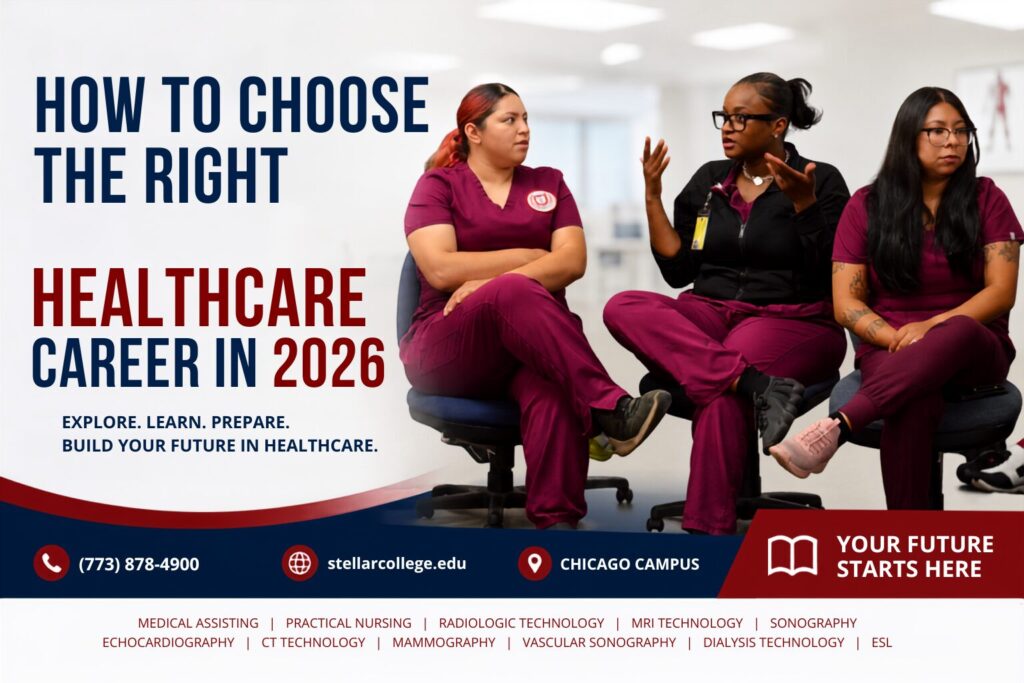
A Guide to Healthcare Career Training
The healthcare field offers a wide range of educational pathways for individuals interested in patient care, medical technology, and specialized healthcare services. Whether you’re beginning your educational journey, considering a career change, or returning to school, selecting the right healthcare program starts with understanding your interests, strengths, and long-term goals.
Each healthcare profession requires a unique combination of technical knowledge, practical skills, and professional communication. Exploring different educational programs can help you identify the learning environment and career pathway that best aligns with your personal and professional objectives.
At Stellar Career College, students can explore a variety of healthcare training programs that combine classroom instruction with hands-on learning in supportive educational settings. This guide provides an overview of each program to help you make an informed decision about your education.
Medical Assisting with Phlebotomy Technician
The Medical Assisting with Phlebotomy Technician Diploma Program is designed for students interested in supporting healthcare teams while developing both clinical and administrative skills. Throughout the program, students receive classroom instruction and hands-on learning in areas such as patient care, vital signs, infection control, medical office procedures, electrocardiography (ECG), specimen collection, and phlebotomy techniques. Training is designed to help students become familiar with the knowledge and practical skills commonly used in healthcare settings.
Practical Nursing
The Practical Nursing Program is designed for students interested in learning the fundamentals of nursing and patient care. Students study anatomy and physiology, nursing principles, pharmacology, infection prevention, patient assessment, and professional communication while participating in laboratory and clinical learning experiences. The program combines classroom instruction with practical training to support student learning in a structured educational environment.
Radiologic Technologist
The Radiologic Technologist Program introduces students to diagnostic imaging principles and the operation of radiographic equipment. Coursework includes patient positioning, anatomy, radiation safety, image evaluation, and professional communication. Students participate in classroom instruction and hands-on learning designed to build familiarity with modern imaging technology used in healthcare environments.
Magnetic Resonance Imaging (MRI) Technologist
The MRI Technologist Program focuses on magnetic resonance imaging procedures and patient-centered imaging practices. Students study anatomy, MRI safety, imaging procedures, patient positioning, equipment operation, and image quality while learning in classroom and laboratory settings designed to support practical skill development.
Diagnostic Medical Sonographer
The Diagnostic Medical Sonographer Program provides instruction in ultrasound imaging principles, anatomy, patient positioning, equipment operation, and image acquisition. Through classroom instruction and practical learning experiences, students develop an understanding of diagnostic ultrasound procedures and the role of sonography within healthcare.
Echocardiography / Noninvasive Cardiovascular Sonographer
The Echocardiography / Noninvasive Cardiovascular Sonographer Program introduces students to cardiac anatomy, cardiovascular physiology, echocardiographic imaging techniques, patient preparation, and ultrasound equipment operation. Students participate in classroom instruction and hands-on learning designed to develop foundational knowledge of noninvasive cardiovascular imaging.
Surgical Technologist
The Surgical Technologist Program prepares students to learn about surgical procedures, sterile techniques, instrumentation, infection prevention, patient safety, and operating room practices. Classroom instruction is combined with practical laboratory experiences that help students understand the responsibilities associated with supporting surgical teams.
Surgical Assistant
The Surgical Assistant Program provides instruction in surgical procedures, anatomy, perioperative patient care, surgical instrumentation, and operating room protocols. Students participate in classroom and laboratory learning experiences designed to build knowledge of surgical support practices within healthcare environments.
Computed Tomography (CT) Technologist
The Computed Tomography Technologist Program focuses on cross-sectional diagnostic imaging procedures. Students study CT imaging principles, anatomy, patient positioning, radiation safety, image quality, and equipment operation while participating in classroom instruction and practical learning experiences.
Mammography Technologist
The Mammography Technologist Program provides instruction in breast imaging procedures, patient positioning, radiation safety, image acquisition, quality assurance, and professional communication. Students develop knowledge of mammography practices through classroom instruction and practical training.
Vascular Sonography Technologist
The Vascular Sonography Technologist Program introduces students to vascular anatomy, Doppler ultrasound principles, blood flow assessment, patient preparation, and diagnostic imaging procedures. Classroom instruction and laboratory learning experiences help students develop foundational knowledge of vascular imaging.
Dialysis Technologist with Phlebotomy Technician
The Dialysis Technologist with Phlebotomy Technician Program provides instruction in renal care, dialysis procedures, infection prevention, patient monitoring, specimen collection, and phlebotomy techniques. Students participate in classroom instruction and practical learning experiences designed to develop healthcare knowledge and technical skills.
Frequently Asked Questions
The right program depends on your interests, learning preferences, and educational goals. Some students are interested in direct patient care, while others prefer diagnostic imaging or specialized healthcare technologies. Speaking with an admissions representative can help you explore available programs and determine which educational pathway best aligns with your goals.
Programs such as Medical Assisting with Phlebotomy Technician, Practical Nursing, Surgical Assistant, and Dialysis Technologist with Phlebotomy Technician include instruction and practical learning experiences related to patient care in educational settings.
Radiologic Technology, Magnetic Resonance Imaging (MRI), Diagnostic Medical Sonography, Echocardiography, Vascular Sonography, Computed Tomography (CT), and Mammography focus on diagnostic imaging technologies used within healthcare.
Yes. Prospective students are encouraged to schedule a campus tour to explore the learning environment, view classrooms and training facilities, and meet with the admissions team.
Each program has a dedicated information page describing curriculum, admissions requirements, and program objectives. You can also contact the admissions team for additional information and guidance.
Getting started is simple. Contact the admissions team to discuss your educational goals, learn more about available programs, and schedule a campus tour. The admissions team can explain the admissions process and answer your questions.
Ready to Learn More?
Choosing the right healthcare program is an important step toward your educational goals. At Stellar Career College, our admissions team is available to answer your questions, discuss available programs, and help you explore the educational pathway that best fits your interests.
Stellar Career College
Where Your Future Starts with Education.